
Introduction
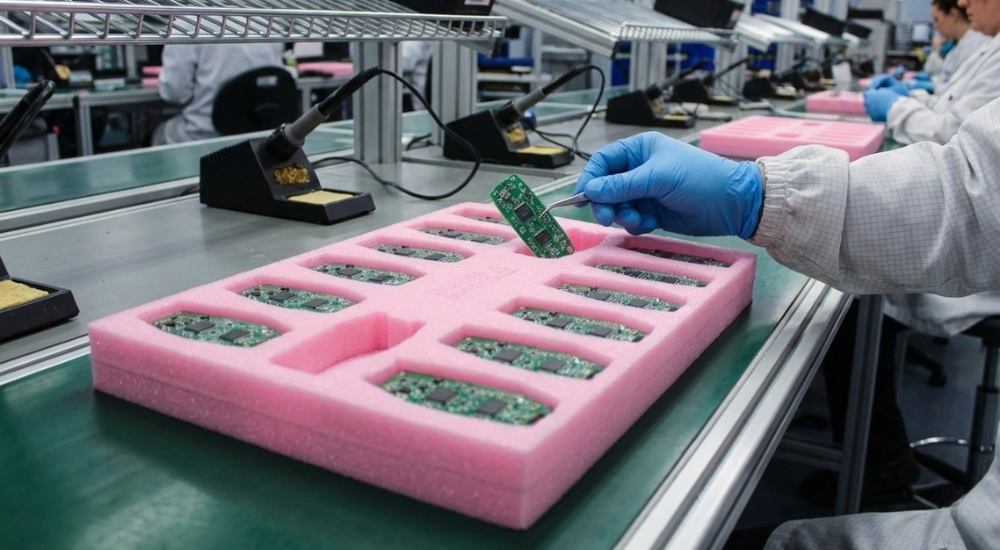
ESD foam is one of the most effective ways to protect your sensitive electronic products from electrostatic discharge during handling, storage, and transit.
It is a specialised packaging material designed not just to physically cushion your products, but to actively control and reduce any build-up and transfer of static electricity that can silently damage delicate electronic components.
To understand why ESD foam matters so much, it helps to start with the problem it is designed to solve.
Contents
Understanding electrostatic discharge
Electrostatic discharge, or ESD, is the sudden flow of electricity between two objects that carry different electrical charges. It’s something most people experience in everyday life – like a small shock when touching a metal door handle after walking across a carpet.
This happens because of how electrical charges build up within materials.
At a microscopic level, all matter is made up of atoms containing:
- Protons (positive charge)
- Electrons (negative charge)
- Neutrons (neutral)
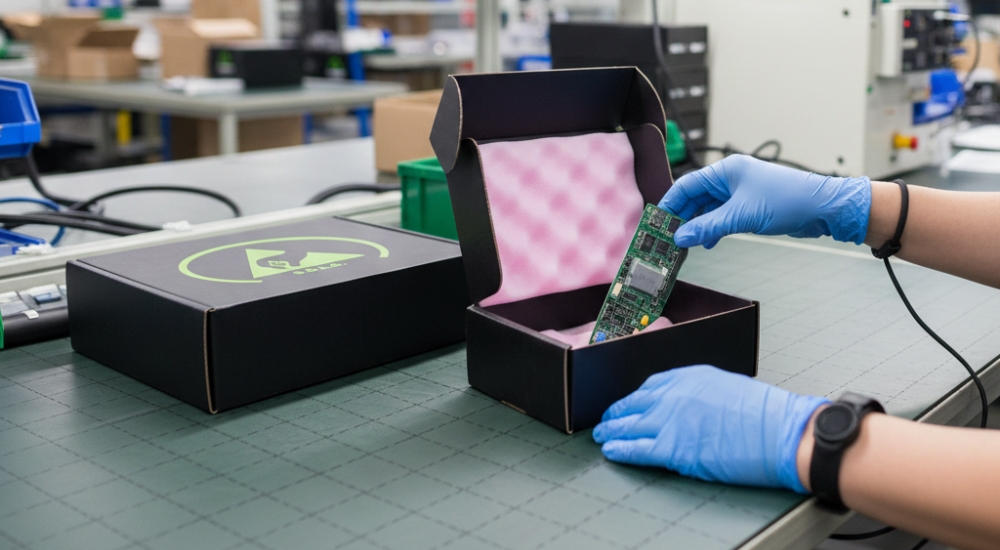
These types of charges are typically balanced, however, when two different materials come into contact and then separate, electrons can transfer charges between them through friction or movement.
This process is known as triboelectric charging.
One material becomes positively charged, the other negatively charged. When that imbalance becomes large enough, the charge suddenly discharges to restore equilibrium. That discharge is ESD.
In humans, ESD is usually completely harmless, but for your electronic products and components, it is not.
Why is ESD a risk for your electronics?
Modern electronic components such as microchips, semiconductors, and printed circuit boards are manufactured at extremely small scales. This makes them highly sensitive to even tiny electrical changes.
When ESD charges occur, they release a rapid burst of energy and heat, and although this energy is on a microscopic scale, it can still be powerful enough to damage or destroy your delicate circuitry.
This creates two potential damage risks:
- Catastrophic damage: The product or component will stop working completely.
- Latent damage: The product might pass initial testing and appear functional, but internal issues can lead to premature failure later in its lifecycle.
The hidden failures that can occur here can lead to frequent failures in the field, increased warranty claims, and potential system downtime long after the product has even left the manufacturing process.
Where does ESD come from?
Electrostatic discharge can be generated in a few different ways throughout the manufacturing, handling, and logistics processes.
Human movement is one of the most common causes. Walking, handling components, or even simple body motion can generate a significant static charge. Equipment such as conveyors, automated machinery, and transport tools also contributes due to friction and motion.
Even materials themselves, particularly plastics and other insulating substances, can retain and transfer charge without direct contact via induction.
This means that even in controlled manufacturing environments, ESD is a constant background risk. Once products leave these controlled spaces, the risk of exposure increases significantly.
Why is ESD foam essential to protection?
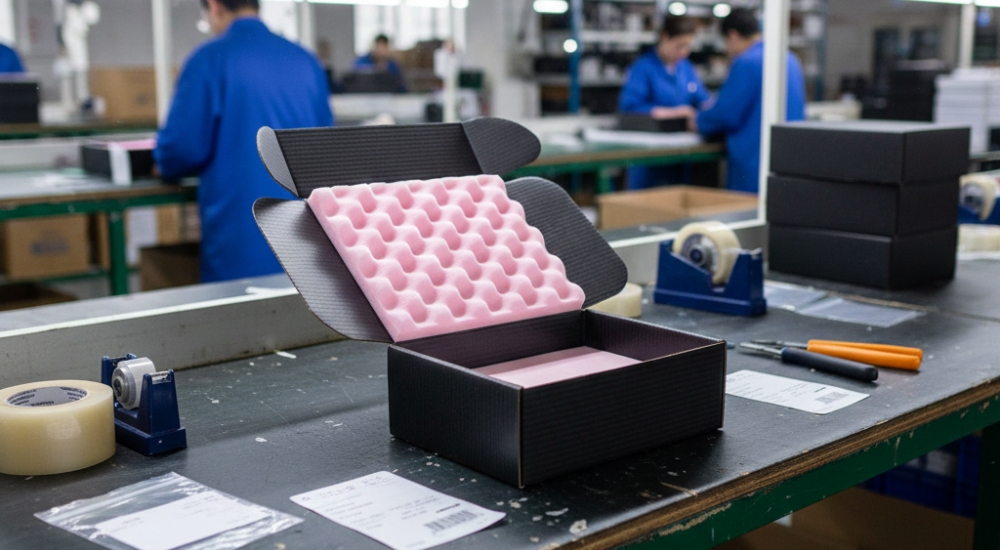
Unlike standard foam packaging, ESD-safe foam has been designed specifically to manage static electricity and any physical impacts. It is designed to prevent the buildup of charge, safely dissipate it, or conduct it away from sensitive components, as it can cause harm.
This dual function – mechanical cushioning combined with electrostatic control – is what makes it so valuable in electronics packaging.
ESD foam works by using specialised material properties that influence how electrical charges behave. Some forms are designed to reduce the generation of static in the first place, while others control or safely redirect charges that do form.
In practice, this means a product placed in ESD foam is not only physically protected from shock, vibration, and movement but also electrically protected from invisible forces that could damage it.
How does ESD foam work in practice?
Different types of ESD foam achieve protection in slightly different ways, but all serve the same overall purpose: controlling electrostatic risk during handling and transit.
- Anti-static protection reduces the buildup of static electricity by minimising charge generation through friction. This is often used as a first line of defence, particularly for less sensitive components or as part of layered packaging systems.
- Dissipative protection slows the electrical charges from moving across the surfaces of the product and gradually dissipates any static energy in a controlled way.
- Conductive protection allows any electrical charges to flow safely through the material and away from the product, creating a controlled path for energy to dissipate, often forming a protective barrier around the component.
Together, these material behaviours ensure that static electricity is either prevented, controlled, or safely neutralised before it can reach vulnerable electronics.
What's the cost of ignoring ESD protection?
The impact of ESD damage is not always immediate, which makes it particularly costly for businesses.
A single undetected latent defect can lead to system failure long after the product has been shipped and installed. This can result in warranty claims, replacement costs, service engineer callouts, and downtime for end users. In more complex systems, one failed component can compromise an entire assembly.
Over time, any repeated failures will affect your brand’s reputation and customer trust, especially in industries where reliability is essential to everyone’s success.
Investing in effective ESD-safe foam packaging will significantly reduce these risks by ensuring protection extends beyond the factory floor and throughout the entire supply chain.
Summary
Electrostatic discharge may be invisible to the naked eye, but it is still a very real threat to your products. It can destroy your components instantly or create hidden weaknesses that only appear later in the product lifecycle.
ESD foam provides a practical, reliable solution to this problem. Combining static control with physical protection ensures that sensitive electronics remain safe from production through to end use.
For any business handling electronic components, it is essential to protect product performance, reliability, and reputation.
Speak to a member of our team today to discuss your specific protective ESD packaging requirements.